
Throwing his support behind globalisation efforts, Lamy decries Trump’s ‘mafia-like hostage-taking’ and says WTO may have to work, for now, without the US
Published: 9:38pm, 28 May 2025Updated: 9:47pm, 28 May 2025
Against the backdrop of tariff negotiations between the United States and various countries, there is “common ground” on which China and the European Union can work together and ensure that mutual and open trade remains a rules-based game, according to a former head of the World Trade Organization.
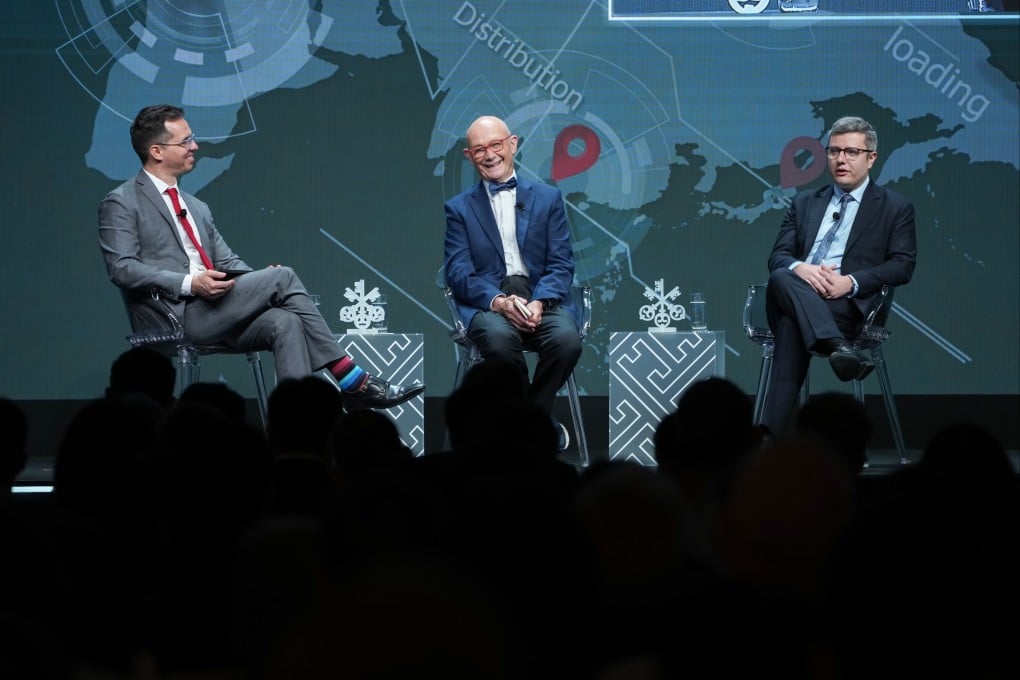
“We should do what China did to us 30 years ago,” Pascal Lamy told the Post on Wednesday on the sidelines of the UBS Asian Investment Conference in Hong Kong, with the message being: “Welcome to the EU, provided you produce here.”
Chinese investment in electric vehicles is the kind of investment that the EU wants, added the Frenchman, who is now coordinator of the Jacques Delors think tank network based in Paris.
The other common interest that China and the EU share is their decarbonisation drive, because “the direction of travel” between both sides is the same and “there is a lot of cooperation capacity there”, he noted. However, he added that China was not “moving rapidly enough” by still relying heavily on coal amid its decarbonisation push.
Lamy’s comment came as the world has been grappling with uncertainties introduced by US President Donald Trump’s tariff policies since his return to the White House in January.
This is mafia-like hostage-taking
Pascal Lamy
Trump imposed so-called reciprocal tariffs against almost all trading partners in April and threatened last week to slap 50 per cent tariffs on the EU from June 1, though he later postponed the implementation date to July 9.
The US is engaged in tariff negotiations with a number of economies. Earlier this month, Washington reached a deal with Beijing, with both sides agreeing to pause most tariffs imposed since April 2 for 90 days.
But Lamy reckoned that the likelihood of major trading partners getting the “best scenario” – meaning a proper trade deal – out of their tariff negotiations with the US would be “low”, because this is not “the mindset” of Trump.
“He’s looking for an unbalanced deal,” Lamy said, as in: “‘I threaten you, and you pay to remove the threat’ – this is not a balanced deal. This is mafia-like hostage-taking.”
On Friday, at a conference hosted by the Centre for China and Globalisation in Beijing, a group of ambassadors, including the EU’s, called for an overhaul of the world’s multilateralism systems to immediately address the political and economic chaos unleashed by Trump.
“You need enough coordination to increase the efficiency of countermeasures now,” Lamy said on Wednesday, echoing their sentiment. “Trade works with an international division of labour. The countermeasures of China and the countermeasures of the EU – if they are to do that – are complementary.”
How are Chinese citizens feeling the effects of the US-China tariff war?
There can be a “united front” for making sure that the World Trade Organization works, for the moment, without the US, according to Lamy, who said he believed in globalisation.
“How can they send a signal together that would rally other countries multilaterally – we stick to the notion that trade opening is a rules-based game,” he added.
“It’s more difficult if China does it by itself,” he explained, noting how doing so would be perceived by a number of countries as “anti-US” action. “If you and China do it together, then you remove the sort of reluctance that some countries would have, and you send a signal [that is] important for the future, which in my view has value for the world economy.”
Given the size of the US economy, and its “relatively” high level of imports compared with exports, Lamy explained that Trump believes “he has a weapon” to wield in the negotiation process. But Lamy said that the chances of the EU accepting an unbalanced deal in the face of Trump’s tariff threat “are very low”.
Meanwhile, Lamy said that trade talks between the US and EU were independent from US-China talks, as Trump is “hitting bilateral relationships”.
“Where [the trade talks] are not independent is with the fact that, if China exports less to the US, China will export more elsewhere, and this may have a knock-on effect on the EU-US and EU-China relationships,” he said.
Amid heightened geopolitical uncertainties, Beijing has been trying to forge closer ties with European economies. President Xi Jinping urged greater cooperation with Germany last week in his phone call with Germany’s new chancellor, Friedrich Merz. Also last week, French President Emmanuel Macron said he and Xi spoke by phone and agreed to move quickly to resolve a trade dispute over cognac tariffs.
In April, Chinese sanctions on five members of the European Parliament, and on the parliament’s subcommittee on human rights, were lifted.
Speaking on China’s overcapacity issue, which has been a long-standing concern among the European bloc, Lamy said China needed “to address the root cause of underconsumption”.
“The root cause of underconsumption is over-saving, and the root cause of over-saving is the non-existence of a proper social security system – education, pension, health,” he explained. “The price that Chinese households pay for a service is too high because of not enough competition.”
Lamy suggested that the wealthy should be taxed, and that there is a need for “a proper redistribution system”.
During the 90-day pause of large-scale tariffs, analysts have said Trump’s implementation of a more tactical and targeted approach to prohibit the use of advanced Chinese chips could cast a shadow over ongoing trade talks.
But Lamy said that the notion of “fairness” is “relative”, and it “only exists in concrete situations”.
“Two countries agree on a trade regime which both sides believe is fair – that’s the end of the negotiation – when both sides say, ‘I take that deal because I believe it’s fair’,” he said.
 Pascal LAMY